Peterson Cat Fluid Analysis Laboratory
Peterson's Fluid Analysis Laboratory in Eugene, Oregon specializes in testing equipment fluids to detect signs of component failure. This service is a health check of your machine to avoid failures and unexpected downtime. Monitoring fluid condition through analysis can prevent issues like overheating and excessive wear, protecting your machinery.
All tests, tools, and supplies are available from the parts counter.
Standard SOS Kit
Standard SOS Kit
Part No.: SOS-1
Qty 50: SOS-50
Our most popular and versatile fluid test kit. Can be used for oil, coolant level 1 and fuel level 1 analysis.
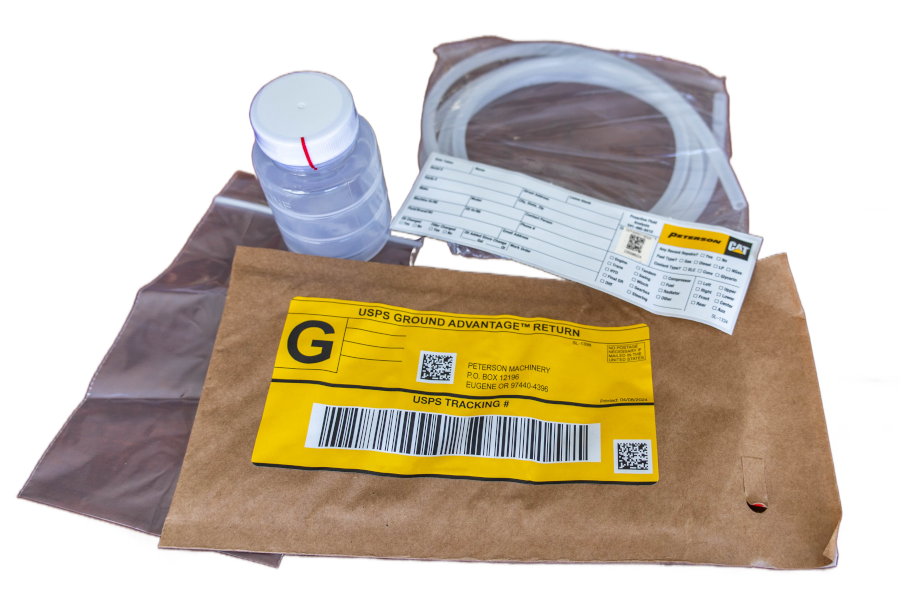
Standard SOS Kit Details
Oil Analysis
- 20 Elements
- True Kinematic Viscosity
- Oil Condition Analysis for Soot, Oxidation, Nitration, and Sulfur
- Contaminants Water, Fuel, and Glycol
- Heavy Metal Analysis
Hydraulic and Filtered Transmission Compartments:
- Particle Count, when required
Level 1 Coolant
Coolant sample turnaround time (TAT) expected seven to ten days from arrival at the lab.
- pH
- Glycol
- Freeze point
- Boil point
- Conductivity
- Color
- Oil
- Molybdate
- SCA (nitrite)
- Appearance
- Foam
- Turbidity
- Precipitate
- Ammonia
Level 1 Fuel
- 20 Elements
- Particle Count 11171
- Microscopic Image
SOS with TBN Analysis
SOS with TBN Analysis
Part No.: SOS-TBN
This SOS kit can be used for oil and includes a total base number (TBN) analysis.
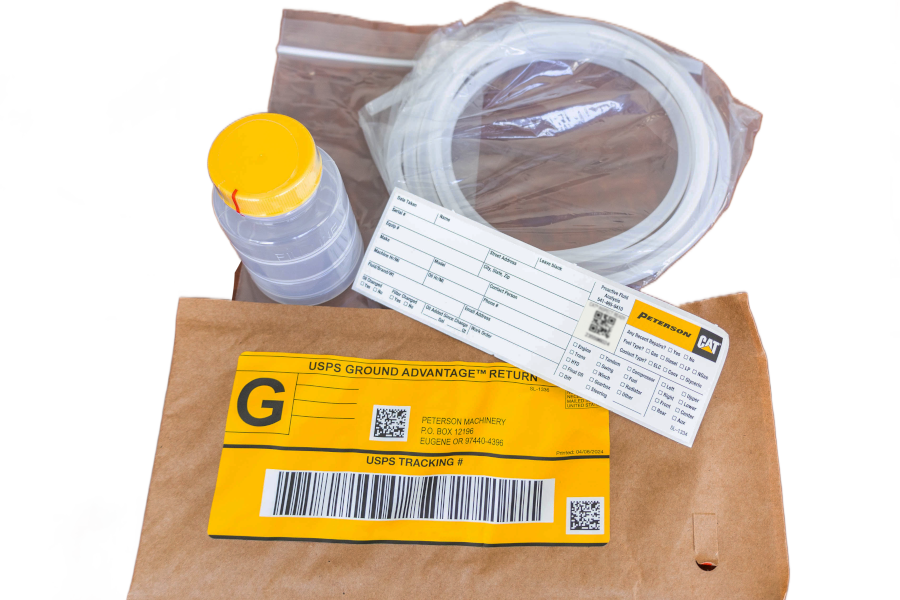
SOS with TBN Analysis Details
Oil Analysis
- 20 Elements
- True Kinematic Viscosity
- Oil Condition Analysis for Soot, Oxidation, Nitration, and Sulfur
- Contaminants Water, Fuel, and Glycol
- Heavy Metal Analysis
Hydraulic and Filtered Transmission Compartments:
- Particle Count, when required
TBN of a used lubricant is a measurement of its ability to neutralize acid using basic buffers; this is a test for engines. All diesel fuels contain some sulfur, but the amount is determined by the amount of sulfur in the crude oil and/or the refiner’s ability or desire to remove it. One of the functions of lubricating oil is to neutralize sulfur byproducts (sulfurous and sulfuric acids), as well as organic acids formed by oxidation. In this way, the oil helps prevent corrosive damage. Additives in the oil contain alkaline compounds formulated to neutralize these acids. The measure of reserve alkalinity in the oil is known as the TBN. Generally, the higher the TBN value, the more reserve alkalinity capacity the oil contains. This test can benefit users of low-ash oils, where the window between good/bad is very narrow.
SOS with TBN & TAN Analysis
SOS with TBN & TAN Analysis
Part No.: SOS-TBNTAN
This SOS kit can be used for oil and includes a total base number (TBN) and Total Acid Number (TAN) analysis.
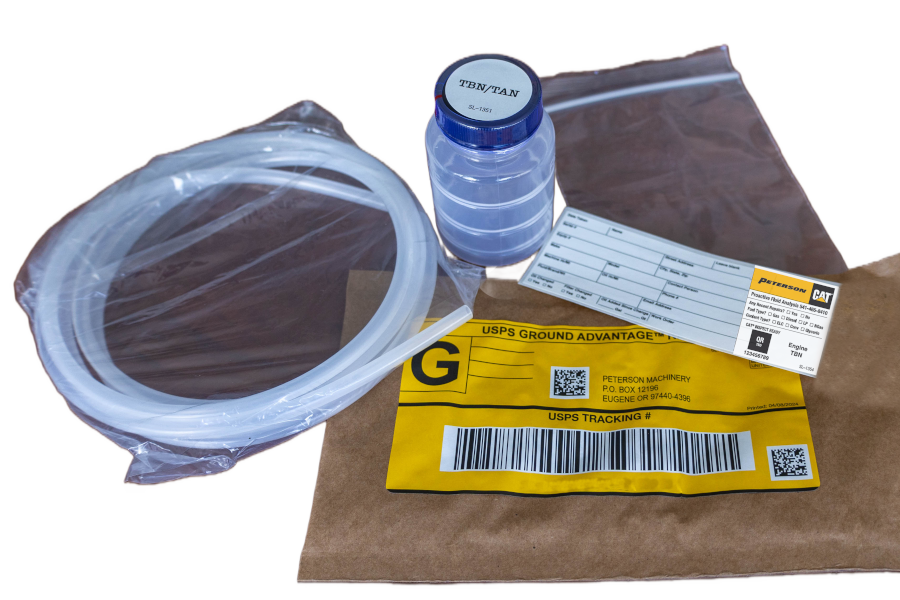
SOS with TBN Analysis Details
Oil Analysis
- 20 Elements
- True Kinematic Viscosity
- Oil Condition Analysis for Soot, Oxidation, Nitration, and Sulfur
- Contaminants Water, Fuel, and Glycol
- Heavy Metal Analysis
Hydraulic and Filtered Transmission Compartments:
- Particle Count, when required
TBN of a used lubricant is a measurement of its ability to neutralize acid using basic buffers; this is a test for engines. All diesel fuels contain some sulfur, but the amount is determined by the amount of sulfur in the crude oil and/or the refiner’s ability or desire to remove it. One of the functions of lubricating oil is to neutralize sulfur byproducts (sulfurous and sulfuric acids), as well as organic acids formed by oxidation. In this way, the oil helps prevent corrosive damage. Additives in the oil contain alkaline compounds formulated to neutralize these acids. The measure of reserve alkalinity in the oil is known as the TBN. Generally, the higher the TBN value, the more reserve alkalinity capacity the oil contains. This test can benefit users of low-ash oils, where the window between good/bad is very narrow.
TAN of a used lubricant is one measure of its degree of degradation by oxidation; this test is primarily for sour gas applications and other non-engine compartments, like landfill, methane, natural gas, hydraulic, or pump applications. TAN is an analytical test we use to determine the deterioration of lubricants: the more acidic a lubricant is, the further its degradation has progressed. As oils or hydraulic fluids break down, they generally form acidic byproducts that can be corrosive to metal components, accelerate wear, form deposits, and increase viscosity. As a fluid degrades, the levels of corrosive acids increase along with the danger of component failure. Oxidation, as measured by infrared spectroscopy, correlates well with TAN.
Level II Coolant Test Kit
Level II Coolant Test Kit
Part No.: COOLANT-2
This coolant test kit includes all the critical tests of a single SOS kit and advanced testing of chemical composition to provide an in-depth view of coolant condition.
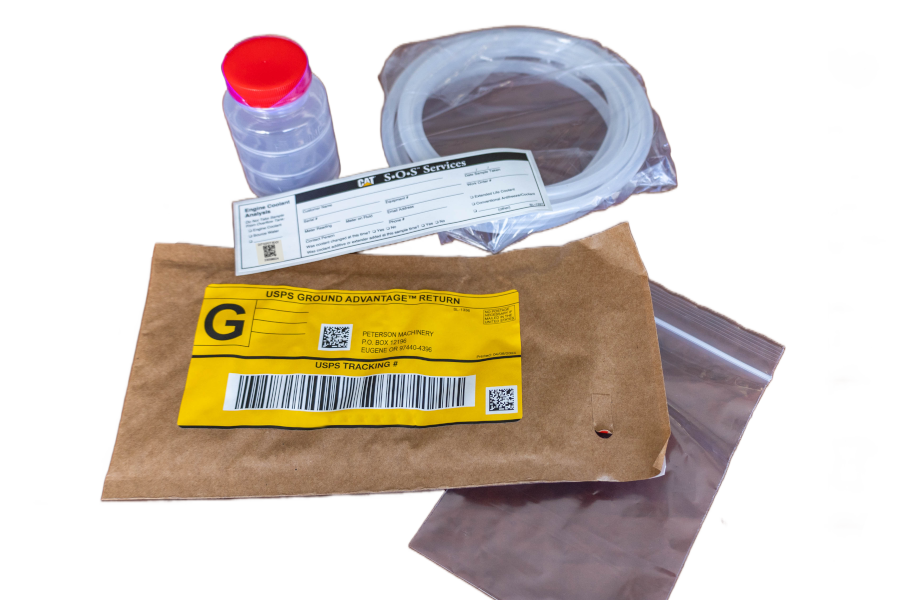
Level II Coolant Test Kit Details
Coolant sample turnaround time (TAT) expected seven to ten days from arrival at the lab.
Level II Coolant Includes
- pH
- Glycol
- Freeze point
- Boil point
- Conductivity
- Color
- Oil
- Molybdate
- SCA (nitrite)
- Appearance
- Foam
- Turbidity
- Precipitate
- Ammonia
Inhibitors
- Nitrite
- Nitrate
- Silicate
- Molybdate
- Phosphate
- Borate
- Sebacate
- Sodium
- Potassium
Contaminants
- Glycolate
- Formate
- Carbonate
- Chloride
- Sulfate
- Total Hardness
- Calcium Hardness
- Magnesium Hardness
- Ammonia
Corrosion Products
- Iron
- Copper
- Aluminum
- Lead
- Tin
- Zinc
Level II Diesel Fuel Test Kit
Level II Diesel Fuel Test Kit
Part No.: FUEL-2
This fuel test kit includes all the tests of a single SOS kit and an analysis of microbial growth and may include usage of the plate count system.
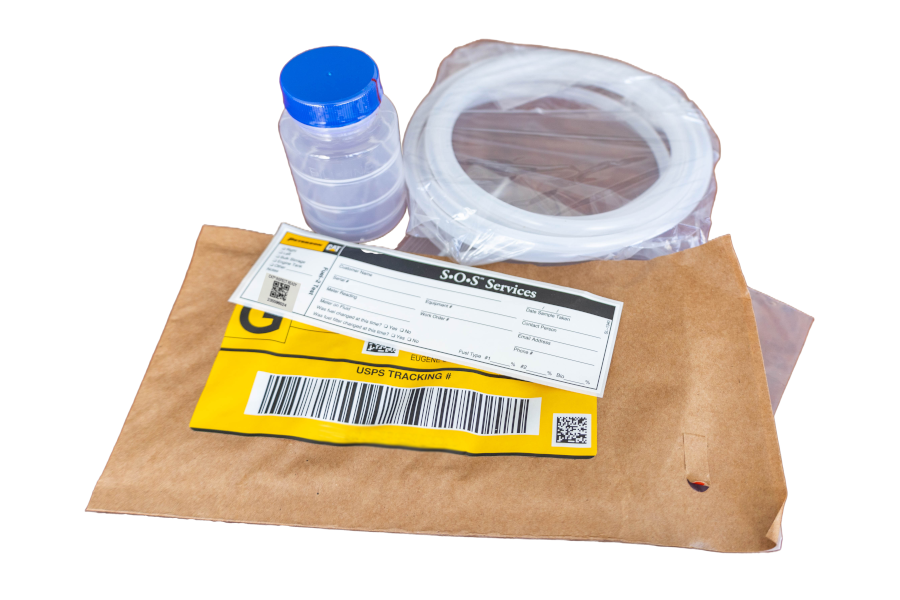
Level II Diesel Fuel Test Kit Details
Level II Fuel Includes
- 20 Elements
- Particle Count ISO Code 11171
- Microbial Growth in Fuel, Test Determines the Type and Degree of Infestation
- Usually Measured by the more Expensive Plate Count System
Do I need a Level II Test?
- Are your filters plugging?
- Are there black-pepper-like floaters in your fuel?
- Is there a slimy substance in your fuel?
- Is there water in your fuel?
If you answer yes to any of the above, this test could help you!
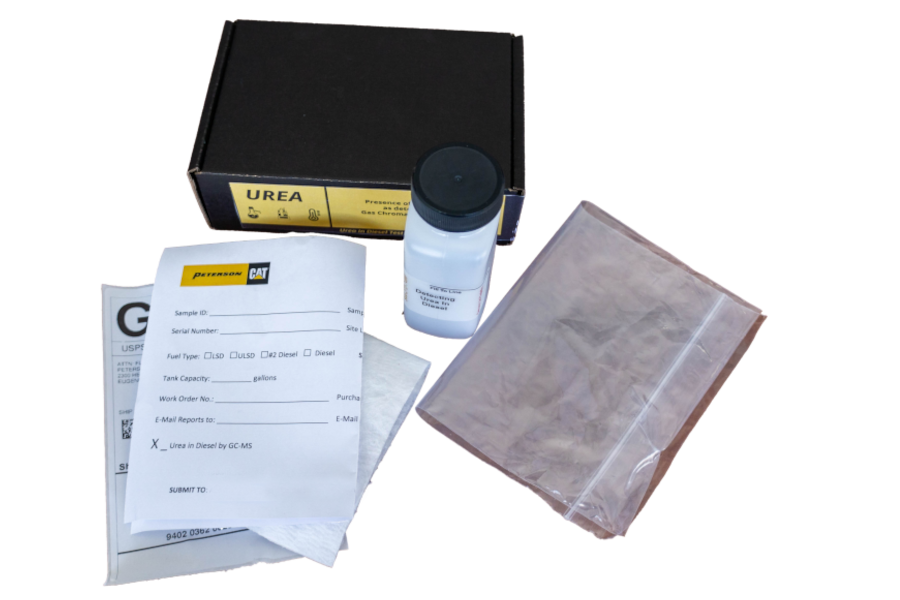
Urea in Diesel Analysis
Urea in Diesel Analysis
Part No.: SOS-UREA
This test detects the presence of urea/diesel exhaust fluid (DEF) in diesel as determined by gas chromatograph analysis. Urea crystallizes when exposed to atmosphere and becomes highly corrosive.
Gasoline in Diesel Analysis
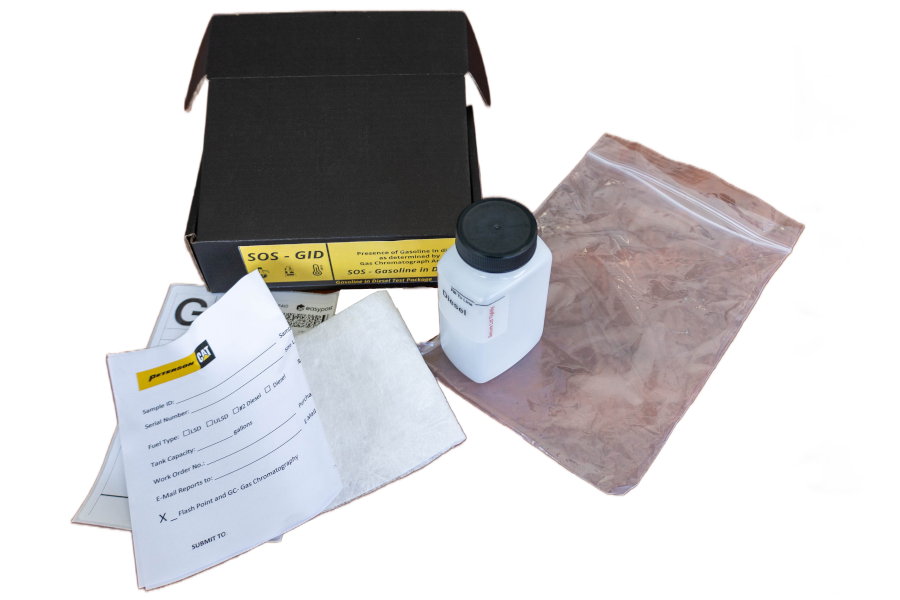
Gasoline in Diesel Analysis
Part No.: SOS-GID
This test detects the presence of gasoline in diesel as determined by gas chromatograph analysis. Gasoline is a lighter molecule with different attributes than diesel fuel. Mixing the two in your diesel engine can damage it.
Advanced Fuel Analysis
| Test Parameter | CSA Fuel Test Part No.: SOS-CSA | Electric Agency Test Part No.: SOS-PGE | SOS Fuel Level 1 Part No.: SOS-LV1 | SOS Fuel Level 2 Part No.: SOS-LV2 |
|---|---|---|---|---|
| API Gravity | ✓ | ✓ | ||
| Bio-Content | ✓ | ✓ | ✓ | |
| Cetane Index | ✓ | ✓ | ||
| Cloud Point | ✓ | |||
| Distillation | ✓ | ✓ | ||
| Flash Point | ✓ | ✓ | ||
| Microbial Growth | ✓ | ✓ | ✓ | ✓ |
| Oxidation Stability | ✓ | |||
| Particle Count | ✓ | ✓ | ||
| Pour Point | ✓ | |||
| Sulfur | ✓ | ✓ | ||
| Visual Appearance | ✓ | ✓ | ✓ | |
| Water & Sediment | ✓ | ✓ | ✓ | ✓ |
| Water | ✓ | ✓ | ✓ | ✓ |
| Hi-Resolution Image | ✓ | ✓ | ✓ |
CSA Fuel Test
Part No.: SOS-CSA
Includes:
- Microbial Growth
- Water & Sediment
- Water, by Karl Fischer
Electric Agency Test
Part No.: SOS-PGE
Includes:
- Bio-Content
- Microbial Growth
- Particle Count
- Visual Appearance
- Water & Sediment
- Water, by Karl Fischer
- Hi-Resolution Image
Level 1 Fuel Test
Part No.: SOS-LV1
Includes:
- API Gravity
- Bio-Content
- Cetane Index
- Distillation
- Flash Point
- Microbial Growth
- Sulfur
- Visual Appearance
- Water & Sediment
- Water
- Hi-Resolution Image
Level 2 Fuel Test
Part No.: SOS-LV2
Includes:
- API Gravity
- Bio-Content
- Cetane Index
- Cloud Point
- Distillation
- Flash Point
- Microbial Growth
- Oxidation Stability
- Particle Count
- Pour Point
- Sulfur
- Visual Appearance
- Water & Sediment
- Water, by Karl Fischer
- Hi-Resolution Image
Tools and Supplies
| Description | Part No. |
|---|---|
| 3/16" Tubing, 100' Roll | 1U8757 |
| Blank Live Valve Dust Cover | 6V0852 |
| Brake Oil Anti-chatter, 1 qt. | 6223149 |
| Coolant Conditioner Test Kit | 4C9301 |
| Engine Live Valve Dust Cover | 8C3445 |
| Filter Cutter | 1757546 |
| HYD Live Valve Dust Cover | 8C3451 |
| Hydraulic Oil Anti-chatter, 1 qt. | 1U9891 |
| Live Valve, Size 1/4X 18 NPTF | 7X3387 |
| Live Valve, Size 7/16X20 | 8C3446 |
| Live Valve, Size M10X1 | 8C3345 |
| Oil Dye, Blue | 4861536 |
| Oil Dye, Red | 4861535 |
| Sample Gun | 5907889 |
| Sample Probe | SOS-PROBE |
| Test Strips Refill Kit | 4C9297 |
| Trans Live Valve Dust Cover | 8C3447 |
| Tubing Cutter | 1U7648 |
| Ultraviolet Dye, 1 oz. | 1U5572 |
| Ultraviolet Dye, 1 pt. | 1U5573 |
Fluid Analysis Frequently Asked Questions
Why do my diesel fuel filters keep plugging?
Repeatedly plugged fuel filters may indicate excessive particles, water, microbial growth, or another form of fuel contamination. A diesel fuel analysis can measure particle count and check for water, sediment, and microbial growth. Testing the fuel alongside inspecting the machine can help identify the cause before additional filters or fuel-system components are affected.
Can coolant analysis help diagnose an overheating engine?
Yes. Although overheating can have several mechanical causes, coolant analysis can identify problems with glycol concentration, pH, freeze point, boil point, conductivity, inhibitors, contaminants, and corrosion products. Testing the coolant can help determine whether coolant condition or contamination is contributing to the overheating problem.
What fluid should I test if my engine or machine is showing unusual wear?
Start with an oil analysis. Used-oil testing can detect wear metals, contaminants, changes in viscosity, soot, oxidation, nitration, sulfur, fuel dilution, glycol, and water. The results can provide evidence of internal component wear or fluid deterioration and help guide the next mechanical inspection.
What should I test if a diesel engine starts running poorly after refueling?
A fuel analysis can help check for water, sediment, excessive particles, microbial growth, gasoline, or diesel exhaust fluid contamination. Peterson offers dedicated tests for gasoline in diesel and urea or DEF in diesel. Because poor performance can have other causes, the fuel-test results should be considered alongside a normal engine and fuel-system inspection.
What causes black particles or slime in diesel fuel?
Black, pepper-like particles, slime, water, and repeatedly plugged filters can be signs of microbial contamination in stored diesel fuel. A Level II diesel fuel test can evaluate microbial growth and help determine the type and degree of contamination.
Which fluid-analysis kit should I use?
The standard SOS-1 kit can be used for oil analysis, Level I coolant analysis, or Level I fuel analysis. More specialized kits are available for TBN and TAN testing, Level II coolant analysis, Level II diesel fuel analysis, gasoline in diesel, DEF in diesel, and advanced fuel testing. Contact the Peterson Cat Fluid Analysis Laboratory if you are unsure which test matches your equipment or symptoms.
What is the difference between TBN and TAN oil analysis?
Total Base Number, or TBN, measures an oil's remaining ability to neutralize acids and is commonly used for engine oils. Total Acid Number, or TAN, measures increasing acidity associated with fluid degradation and is often useful for non-engine compartments and applications involving natural gas, landfill gas, hydraulics, or pumps.
How long does coolant analysis take?
Coolant sample turnaround time is generally expected to be seven to ten days after the sample arrives at the Peterson Cat Fluid Analysis Laboratory.
Where can I get oil, coolant, and fuel analysis in Oregon?
Peterson Cat operates a Fluid Analysis Laboratory in Eugene, Oregon, that tests oil, coolant, diesel fuel, and other equipment fluids. Sample kits, testing tools, and supplies are available through Peterson Cat parts counters. Customers can also contact the lab for help selecting the appropriate test.
 WARNING